This artwork was created on the lands of the Wurundjeri and Bunurong people of the Kulin Nation, by artists from Snuff Puppets in collaboration with Fast Fashun.
In consultation with Vitae Veritas.
It was presented by Melbourne Fringe and Abbotsford Convent in October 2025.
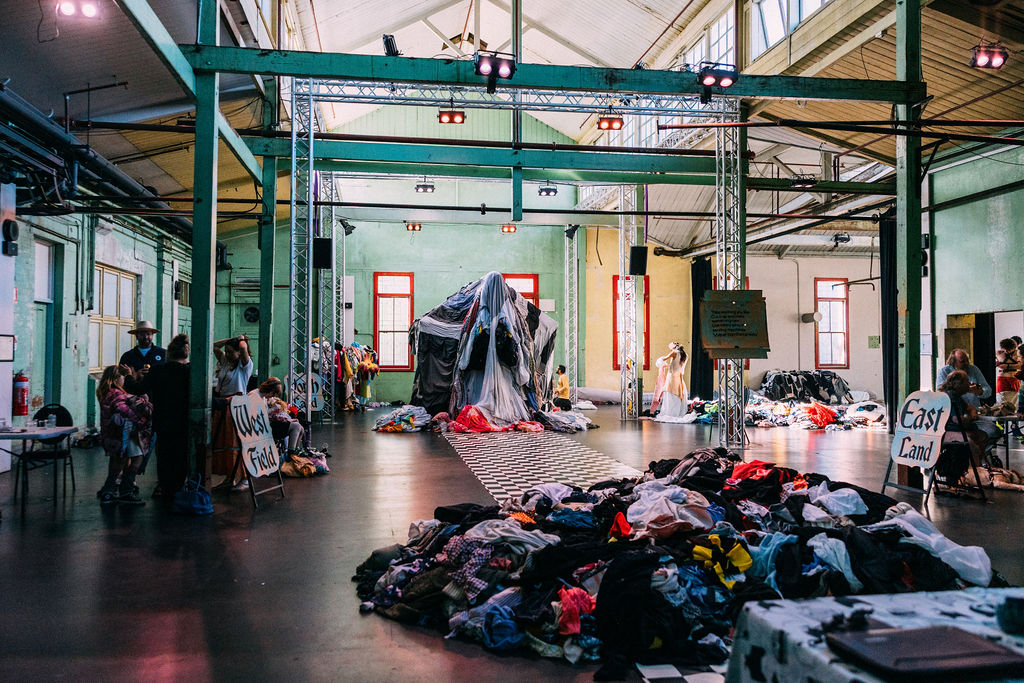
The sculpture begins – as it will be changing, shapeshifting, evolving – but first it appears to you as a huge pile of discarded clothing, as tall as a person standing on the shoulders of another person, with a third person sitting on top of that person. And it’s as long from front to back as two elephants, maybe one is from Asia, the other from Africa. It takes up a roughly rectangular space on the floor – as long as about six adults laying down head to toe, and as wide as two or three laying down head to toe. There’s plenty of cloth under which to swaddle oneself for a nap, so why not.
The puppet is at present all up an enormous amorphous heap of clothing and household fabric waste, the size of a medium-sized truck – larger than the sort you’d need to move out of home, smaller than the sort that can’t really hit the brakes safely on the highway. The truck-shaped heap is slightly rounder where the driver’s cab would be, and a little larger too. If this clothing pile is for a washing day, it’s for an entire town.
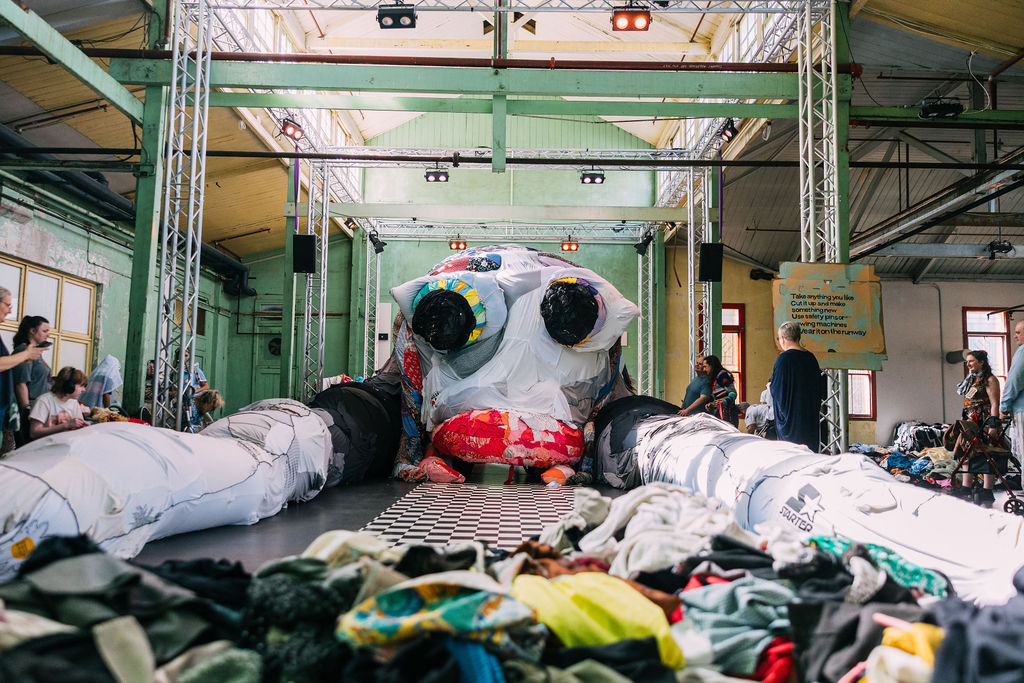
Were this gargantuan garment-garbage sculpture actually a truck it would have a windscreen – instead, at the front of this enormous cart-shaped pile of discarded clothing items, we see two large voids where eyes might be. The front of the object is growing at an almost imperceptible rate at first – perhaps expanding by the size of a hand in every direction every 15 seconds or so – and progressively it is evident that the front of the thing is the shape of a giant skull with a slight rear extension; how 20th-century Australian suburban of it.
The nebulous noggin is about 4 metres in height, 4 metres wide, and when looked at from the side as much as 6 metres from front to rear, and when viewed from the side, an extension thrusting from the rear of the skull shape is the shape of a small house.
Upon closer inspection the clothing items – of which there are hundreds and hundreds – that constitute the skull-house-creature’s flesh have been stitched together by machine, not in the factory but by the artists, and at sharper or more recessed corners and points, seemingly, the rough-hewn stitch of hand labour – the effect of a quilted skin over the part-skull, part-hut being.
The sides of the crude, if brutal, domicile-like rear extension are draped in gloomy tones – absent of brands, logos, or patterns – instead coated in a combination of dark and colourless fabrics cobbled together into an effect that evokes the theatrical. This could be the gathered and scooped curtains of a Victorian orphanage’s gothic annual puppet show, their sad hopeful show about to start – or it could be a hundred discarded hand-stitched petticoats of an early 20th-century wartime can-can dance chorus, sewn from remnants of drab dyeless parachutes and mass-issue uniforms.
As with the external walls, the roof of the house-like structure is shingled in intersecting swathes of black, white, and grey fabric – a continuation of the side curtains but securely tiled. If it rained, the water would roll off the top and linger in the folds of the walls.
At the bottom edges of this domicile, at its foundations, are bright, fleshy, pink tendrils – tightly wound pyjama off-cuts. A few lone strips creep around the corners like the last few remaining jellyfish strewn about from a tidal wave of cloth.
The very back of the house is almost entirely a door – radiating out from it are more tentacles, again of pinks reminiscent of the most delicate human parts – and at once shocking, hysterical, mismatched and clashing. The door is the loudest invitation and a shriek of protest – evocations of ancient war paint and thick zinc on the nose of a beach cricketer on a glorious summer’s day. But we won't go inside just yet.
The creature – and it is a creature – we know this because it seems, very subtly at first, to be breathing. The slow inflation process is not a consistent one. The sound of industrial fans gives away the mechanics of the puppet’s breath, but the effect is no less effective, as the occasional withdrawal of surprised wind in capricious fabric folds fights against billow – and the steady rise and expansion.
The skull-slash-hut with its skin of t-shirts, trousers, skirts, hooded jumpers, underwear, suit jackets, towels, sheet sets, even socks (odd or otherwise) – a mass of waste sourced directly en route to the tip – is rising and falling at most a half-foot at a time, at times gently, at times with a sense of mischief – and the eyes, those shadowed eyes, the only part of the creature without visible remnants of old sports logos or fashionable patterns or stylish design, the eyes are as though bottomless pools – a still and unknowable centre, a dark anchor amongst a plethora of textures and text. The place where nostril bones might be some old sports training gear.
The breathing of the skull becomes more pronounced as the creature grows and grows, and in the lower centre of the skull, where the jaw ought be – a hollow appears. Maybe this void is a mouth.
As the sculpture – sculpture but also SKULL-pture – as the memento mori, what else might one expect of a company called Snuff Puppets – as the sculpture tilts its colossal head back, the cheeks begin to inflate and inflate and at a point where it seems the shape of the skull could no longer sustain itself and it may shapeshift into a balloon with eyes and float skyward, the cheeks collapse outward and begin to unfurl what seem to be tentacles.One from each cheek. Enormous at first – a few metres long – and reaching out in front of the skull-face, each tentacle a patchwork of primarily t-shirts, often sportswear, with logos that read NIKE (the brand perhaps a reference to the Greek goddess of victory), EVERLAST (a popular sports goods label or an ironic reference to the beast born of discarded garments destined for rot in landfill), QUIKSILVER (the Australian surfing fashion stable or a nod to the colloquial name for the metal mercury, that which drove milliners of the Victorian era mad when used to stiffen the felt hats – as we too are poisoned by this endless torrent of fashion trash – or perhaps an oblique reference to the messenger of the gods, Mercury, representative of shopkeepers, merchants, thieves, and tricksters). As many as 50 other popular Australian and international brands are visible – from the cheapest such as Best & Less, Lowes, Kmart house label – to the more fanciful: Prada, flash in the pan, a t-shirt from HUEL, the short-lived disgusting protein supplement drink – that Silicon Valley start-up that promised you’d never need to eat anything else again, just their structured, designed, and well-funded gruel. Other logos and patterns include an atomic symbol, a simple repeated dinosaur print, the word ‘functional’.
The tentacles at full extension are perhaps 6 and a half metres long – these long arms would need a wristwatch with a one-metre strap, and at the shoulder a black armband would measure 2 metres long. On the left tentacle just such a band is attached. The tentacles reach diagonally outward from the skull’s cheeks creating a V-shape, the broadest point of which being the ends of the tentacles, and the acute angle being the inviting mouth.
The tentacles and face are hollow, lightweight, limber, and you can touch them – full of air being pumped (if our ears do not deceive us) from within the skull itself – and with the pumping of the air, that breath-like quality continues and extends to a rhythmic and then at times unpredictable waving, twitching, as though the tentacles are continually feeling the ground beneath them.
About one metre in length are the tips of the tentacles, where the single cylinders split into four or five twisted root-like extensions – these more flamboyant in pattern, colour, and combination of fabric textures – perhaps a more sensitive part of the creature, or perhaps more dangerous.
You could head towards the centre of the mouth, now at full inflation, revealing lips plump and pink as a living human’s – a mottled collection of cinched skirts and shabbily pleated nightwear. The upper lip complete but the lower lip – to this point seemingly also – now splits in the centre and opens up into mandibles, like a snake dislocating its lower jaw – to welcome a meal.
At the base of the mouth – against the ground – a colourless black-and-white checkerboard vinyl flooring, each square about foot-size, you could hopscotch along it if you were very small, or play a game of chess with stuffed toys – this glossy if grubby mouth, playful in its simplicity, but no less threatening or intriguing. Do you dare walk into the mouth of the creature?
Past the lips and mandibles, over the checkerboard square-patterned floor, inside the mouth a few stuffed creatures hung in the air as though gargoyles at the entrance to a French cathedral – or creatures surviving in the gaps where teeth might once have been.
You’re now inside the skull – or is it a hut, or a shack, or a house, or a cave lined with a billowing patchwork of mismatched old childhood sheets, perhaps from grandma’s house, perhaps your own – but no longer of this time, rescued as they were from certain destruction – and you step out the rear of the sculpture. And you’ve passed through the creature.